
The power of relationships
by Tami Nielsen, president and CEO, Food Bank of Iowa
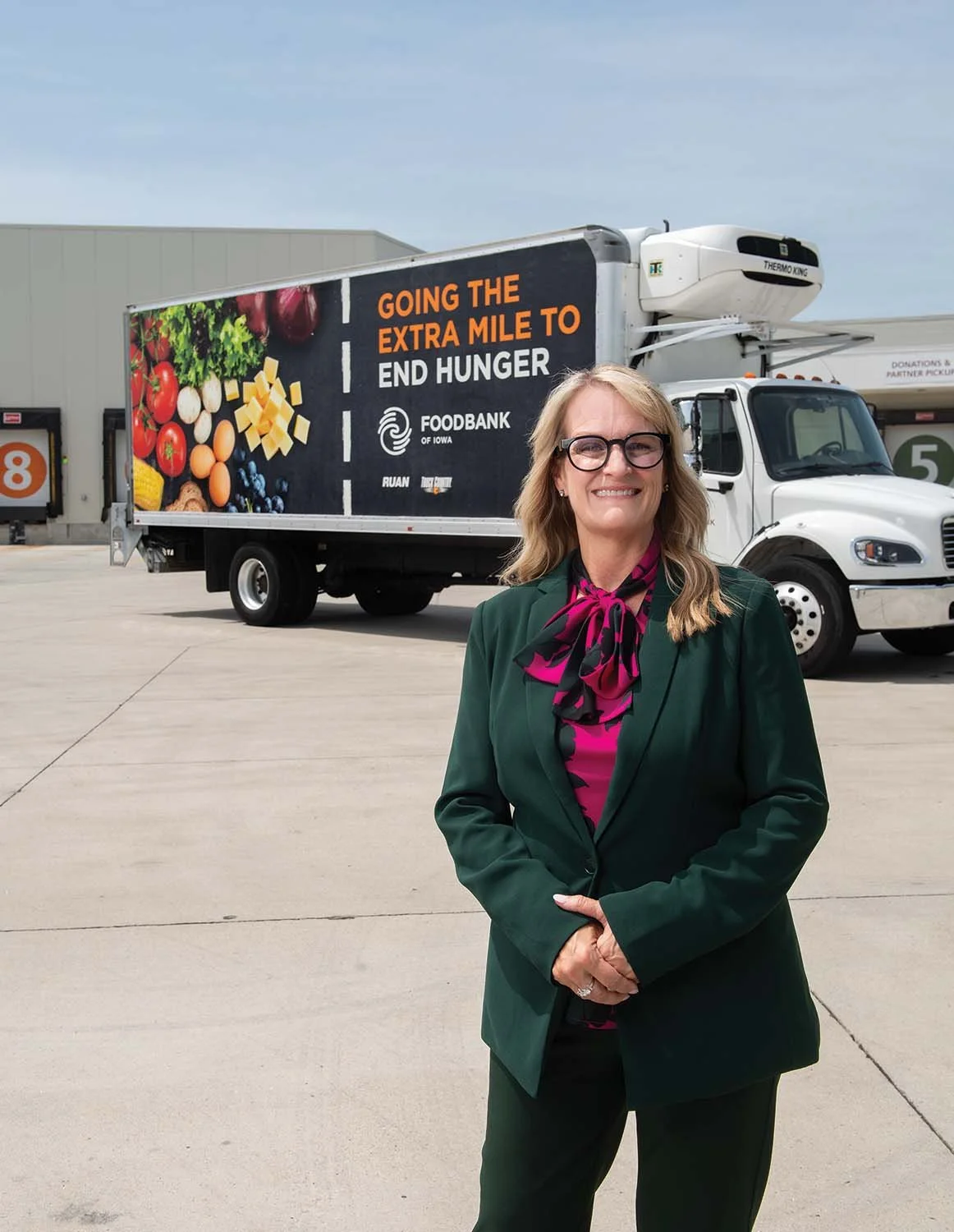
Tami Nielsen. Photo by Duane Tinkey
Tami Nielsen is president and CEO of Food Bank of Iowa. She joined the organization in 2016 and progressively advanced throughout the organization, first working with community partners and then leading food acquisition and delivery as COO before assuming the CEO role in 2025. Nielsen is a graduate of Iowa State University. She and her husband, Todd, live in Johnston. They are the parents of four adult sons and grandparents to five adorable grandchildren.
________________________________
Depending on the source, overall fundraising for nonprofits the past couple of years has been characterized as steady. Stable. Consistent. Even up a modest 3.5% year-over-year, according to the Association of Fundraising Professionals.
Maintaining a consistent source of funds in an uncertain economy is a sigh of relief – and something nonprofits, and all those supporting and counting on us, should celebrate. We are holding our own. Yet it’s important to note some other underlying trends:
Federal funding cuts are hurting many nonprofits: Food Bank of Iowa is not federally funded, but we rely on USDA commodities to help supplement our inventory. And USDA food is at an all-time low of 10% of our inventory – a far cry from pandemic levels of 50% of the food we distributed, or the more recent 25-30% of the past few years. That means we’re buying more food to meet historic levels of need. Even with our buying power, food prices are up and it costs more to get it here. In addition, devastating cuts to the Supplemental Nutrition Assistance Program, known as SNAP, will create a meal gap the charitable food system can’t begin to fill.
Donor value is increasing, which means donors are giving more.
But nonprofits overall are attracting and retaining fewer new donors, particularly among entry-level ($1-100) donors. That “micro” donor group, which made up 57% of all nonprofit donors in Q1 2025, experienced an 11.1% year-over-year drop, “continuing a trend of decreased engagement from small donors early in the year,” according to the most recent data available from the Fundraising Effectiveness Project.
As nonprofit leaders, we have hard, unpredictable work ahead. Fundraising is a dynamic business. We must constantly adapt and innovate to understand donor motivation and build genuine, long-lasting, mutually beneficial relationships.
Donors want to transform, not transact
Our team took a call from a donor a few months ago who just wanted to let us know how much he appreciated receiving a handwritten thank-you note from Food Bank of Iowa. Other charities, he said, continued to ask for support but never stopped to acknowledge his contribution. We were all heartened by that moment.
Expressing gratitude warmly and promptly, with a personal touch, is as basic to us as breathing. Donors should be sincerely thanked for their generosity, and recognized in ways that resonate with them.
Beyond knowing they are valued, donors and supporters want to make an impact. They want to give in myriad ways that work best for them, and they want their gifts to be used effectively. They like to be informed about who they are helping, and how much. They want to be engaged as the true partners they are.
It all starts with connection
Food Bank of Iowa is 100% supported by generous individual, corporate, foundation and food donors. And our relationship with many donors begins with the volunteer experience. (FYI, the average gift to Food Bank of Iowa from a volunteer is 20% more than the average gift overall.)
Across the board, more than 28% of the U.S. population – or more than 75 million people – age 16 and up formally volunteer with organizations each year, according to joint research by the U.S. Census Bureau and AmeriCorps. People volunteer not only to give back, but to build meaningful connections. They want to belong and find shared purpose among a community of advocates. It helps if it’s fun!
That’s the sort of volunteer experience we strive to offer at Food Bank of Iowa, where last year volunteers served nearly 44,000 hours – the work of 21 full-time employees.
The volunteer experience is ingrained in our culture. “Incorporating trained volunteers where beneficial and applicable” is included in every person’s job description at Food Bank of Iowa, and maintaining our Service Enterprise accreditation allows us to leverage the power of volunteers to increase efficiency, effectiveness and scale our mission. With every initiative, we ask, “How can a volunteer support this work?” Volunteers are vital to our daily operations. And our core volunteers – those superheroes who volunteer 50-400 hours a year or more – well, they become family.
If you’ve not had the opportunity to visit Food Bank of Iowa for a volunteer shift (which is just one way to volunteer), I invite you to join us and see for yourself how good it feels to do good.
We value our volunteers’ time. At the beginning of every shift, the playlist is grooving and volunteer coordinators are ready to go.
We respect our volunteers’ expertise. We trust trained volunteers to complete independent and skilled work, including operating forklifts and representing Food Bank of Iowa as community ambassadors.
We hold our volunteers to high standards when it comes to food safety and productivity.
At the end of every shift, we provide a snapshot of what volunteers accomplished during their time with us: pounds of food sorted, bags packed, number of Iowans impacted.
We also consistently ask for feedback: “How can we improve? What can we do better?”
We so believe in the power of community that we’re expanding our parking lot in Des Moines to accommodate more visitors and volunteers. This will allow community groups to gather here more often, it will engage new audiences to experience Food Bank of Iowa firsthand, and most importantly – more volunteers will help us get more food on the table for Iowans facing hunger in the 55 counties we serve. It’s exciting to think about the capacity and connection we will gain with just a little more concrete. We can’t wait to see you!
If you could wave a magic wand and make one wish for the future of the nonprofit sector, what would you wish for?
I’d ask for the standard three wishes, not just one! First, I’d wish for a world in which basic human needs are met, not politicized. Next, I’d wish for vision to see what’s coming so that we can better prepare to move our organizations forward. And last, but certainly not least, the courage to navigate challenges and opportunities, whatever they may be.